Solar Subsidy in Varanasi: 2026 Complete Guide to PM Surya Ghar, Eligibility, Amount, and ROI
If you are planning rooftop solar for your home, understanding Solar Subsidy in Varanasi can save you a significant amount at the time of installation. Many homeowners in Sigra, Bhelupur, Chitaipur, Lahurabir, Shivpur, and Ramnagar start with one question: how much subsidy can I actually get, and what is the correct process?
This guide explains everything in a practical way. We will cover eligibility, real subsidy math for 1kW, 2kW, 3kW, and 5kW systems, application flow, bill savings, payback period, and return on investment. We will also explain common mistakes so you can avoid delays in approval and subsidy credit.
Before comparing numbers, many homeowners first consult a trusted Solar Company in Varanasi to align subsidy eligibility, rooftop feasibility, and monthly savings expectations in one practical plan.
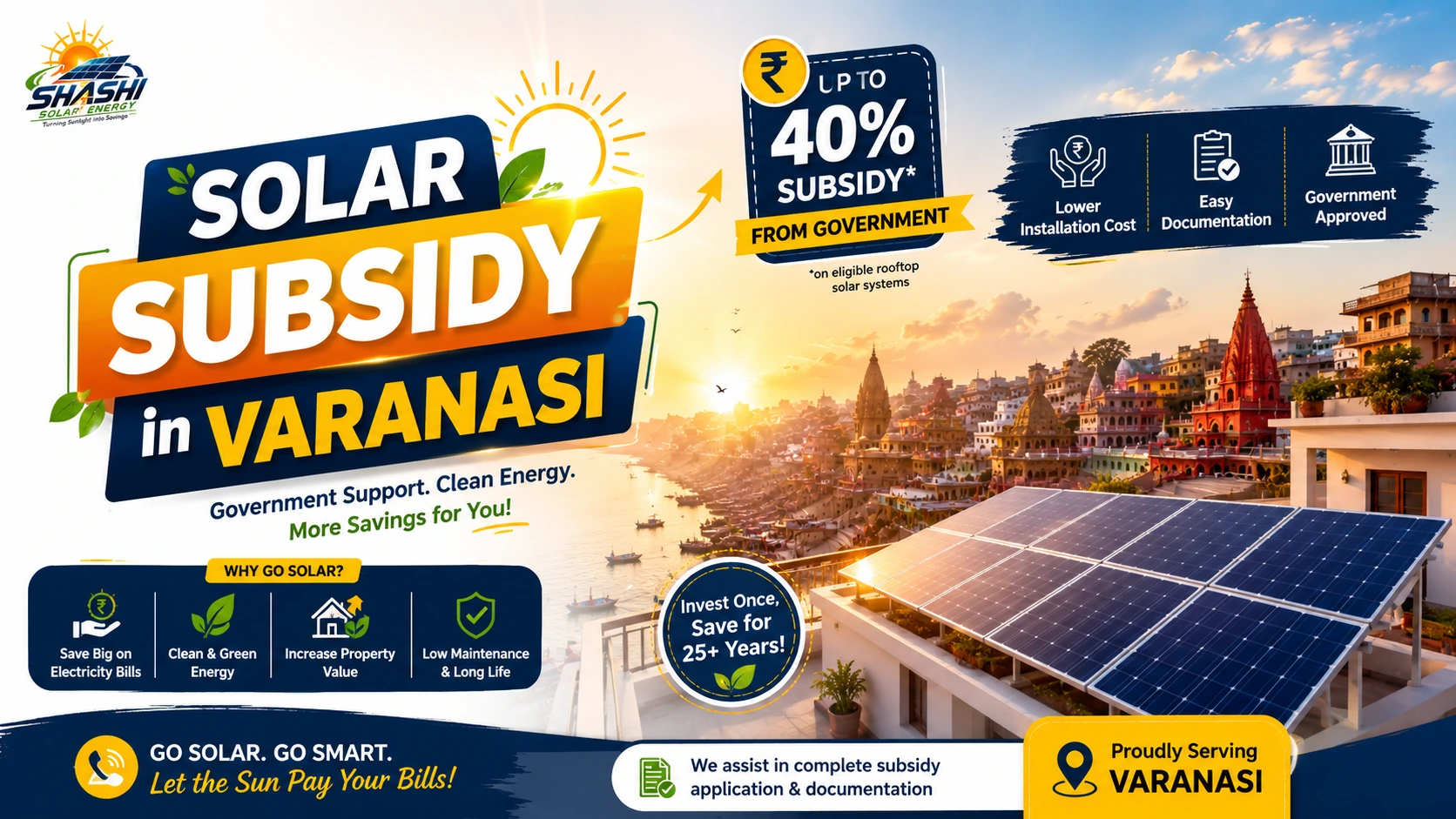
What is the solar subsidy in Varanasi?
Solar Subsidy in Varanasi is the central financial assistance provided to eligible residential consumers who install approved grid-connected rooftop solar systems. In simple words, the government supports part of your installation cost so the switch to solar becomes affordable for families.
Practically, this means you pay less upfront, your electricity bill drops earlier, and your payback becomes faster. However, subsidy is not a random discount. It is rule-based. Your application, vendor, technical specifications, and DISCOM approvals must match current guidelines.
Also, it is important to understand that rooftop solar subsidy in varanasi is mainly linked to residential connections. Commercial and industrial installations usually focus on savings and tax benefits rather than the same household subsidy structure.
Therefore, when people ask about solar panel subsidy in varanasi, the most useful answer is this: check your consumer category first, choose an approved path, and design a system size that balances subsidy and long-term savings instead of subsidy alone.
If you want complete planning help from load analysis to subsidy-ready design, you can connect with a local Solar Energy Company in Varanasi before you finalize the proposal.
How much solar subsidy is available in Varanasi?
The available subsidy is determined by the scheme's CFA structure, benchmark cost logic, and your final approved system capacity. For most residential users in Varanasi under general category structure, the common calculation is:
- First 2 kW: higher CFA rate
- Additional capacity up to 3 kW: lower CFA rate
- Beyond 3 kW for an individual home connection: no additional central CFA
As a result, subsidy increases with size up to a practical cap for individual households. This is why many consumers choose 3kW as a balanced size when roof area and monthly usage support it.
Even so, numbers alone are not enough. Homeowners often compare technical proposals from the Best Solar Company in Varanasi to understand how component quality and engineering decisions affect real savings after subsidy.
At the same time, system size should not be selected only to maximize subsidy. It should match daytime consumption, appliance pattern, and future load plans. If sizing is wrong, even a good subsidy may not deliver expected monthly savings.
So, the smart approach is to calculate total project cost, expected generation, annual savings, and subsidy together before locking capacity.
What is PM Surya Ghar Yojana?
PM Surya Ghar Muft Bijli Yojana is a Government of India initiative designed to accelerate residential rooftop solar adoption. Its broader objective is to help households generate their own electricity and reduce dependence on conventional grid supply for daytime usage.
For live scheme workflow, registration, and updates, homeowners should refer to the official PM Surya Ghar portal.
The scheme is not just a subsidy promise. It is a complete implementation framework with defined workflow: consumer registration, vendor selection, installation standards, DISCOM verification, and direct transfer of subsidy after approval.
Another important point is standardization. The scheme encourages technical compliance, quality components, and documentation discipline so systems perform safely over the long term. This is crucial in cities like Varanasi where rooftop types vary across old homes, multi-floor properties, and new constructions.
In short, PM Surya Ghar combines affordability with process discipline. That is exactly why it is central to today's conversation around Solar Subsidy in Varanasi.
How can I apply for PM Surya Ghar Yojana in Varanasi?
The application process is straightforward if you follow sequence carefully. Most delays happen when users skip steps or upload incomplete details.
A practical flow for Varanasi households is:
- Create your consumer profile and validate mobile/email
- Enter your electricity connection details correctly
- Select eligible vendor options and compare proposal quality
- Finalize system size only after roof and load analysis
- Complete installation as per approved design
- Get inspection, net-meter documentation, and DISCOM acceptance
- Receive subsidy credit post verification
Because execution quality directly affects approvals, many families shortlist a proven Solar Installation Company in Varanasi that can handle documentation and technical compliance together.
Keep your application documents organized from day one. Typical files include identity proof, recent electricity bill, property ownership proof, and bank details. Incomplete or mismatched records are a common reason for delay.
Finally, track status regularly instead of waiting passively. Proactive follow-up usually improves timeline.
Who can apply for PM Surya Ghar Yojana?
In general, residential electricity consumers with suitable rooftop space and valid connection details can apply, subject to current scheme rules. The connection category matters, and your consumer profile should be clean and active.
For many households, eligibility questions are less about intent and more about execution. For example, roof rights in shared-family properties, name mismatch between bill and bank details, or unresolved billing issues can slow the process.
Technical suitability is also part of practical eligibility. If roof shading is heavy or clear area is limited, feasible system capacity may be smaller than expected. In that case, subsidy still applies to approved capacity, but ROI expectations should be recalculated accordingly.
So treat eligibility as a three-part checklist: consumer eligibility, documentation eligibility, and technical eligibility.
How much subsidy is available under PM Surya Ghar Yojana?
As per commonly referenced CFA structure for general-category residential consumers:
- Up to 2 kW: subsidy at the higher slab
- Additional 1 kW (up to 3 kW total): subsidy at the next slab
- Beyond 3 kW: no additional central CFA for individual households
In practical rupee planning, this is widely represented as:
- Rs 30,000 per kW for first 2 kW
- Rs 18,000 per kW for the additional kW up to 3 kW
- Effective commonly seen cap for 3kW and higher household systems: up to Rs 78,000
To avoid confusion during budgeting, review product efficiency, warranty terms, and structure quality with a transparent Solar Panel Company in Varanasi before final cost locking.
Because benchmark cost and policy interpretation can evolve, always verify live values at application time. Even so, this structure is very useful for early budgeting and deciding whether 2kW or 3kW fits your home economics.
The best proposals always show three numbers together: post-subsidy cost, expected annual savings, and conservative payback timeline.
Is PM Surya Ghar Yojana available in Uttar Pradesh?
Yes, PM Surya Ghar is available in Uttar Pradesh, including Varanasi, for eligible residential consumers. In practice, local implementation depends on DISCOM workflow, inspection queue, and document completeness.
Families comparing installers across the state can also review our solar company in Uttar Pradesh service page for broader support details before choosing a vendor.
For Varanasi households, the process usually includes registration, vendor execution, technical verification, and final subsidy credit after approvals are completed. Therefore, timeline can vary based on submission quality and local processing load.
If you want smoother execution, keep your roof survey, load profile, and documents ready before submission. Also, avoid selecting capacity only because a neighbor used the same size. Your tariff, roof shape, and usage pattern may be different.
In short, the scheme is available, but success depends on correct execution from day one.
How much subsidy is available for a 1kW solar system in Varanasi?
Under the common PM Surya Ghar calculation for general-category residential users, a 1kW system is generally associated with about Rs 30,000 subsidy.
Who should consider 1kW?
- Small households with low monthly consumption
- Homes using basic daytime appliances
- Users starting small before future expansion
However, many homes in Varanasi now use coolers, refrigerators, and sometimes ACs. So 1kW can help, but may not offset a large share of total consumption. Compare 1kW and 2kW economics before finalizing.
Often, a slightly larger system delivers better long-term value per rupee invested even if initial cost is higher.
What is the subsidy for a 2kW solar system?
For a 2kW residential rooftop system under standard general-category interpretation, subsidy is commonly estimated around Rs 60,000 (Rs 30,000 per kW for first 2 kW).
A 2kW system is often practical for many Varanasi homes because it balances:
- Reasonable post-subsidy project cost
- Visible monthly bill reduction
- Manageable roof area requirement
If your home consumes moderate units and daytime load is stable, 2kW can be a strong value option. Still, if your monthly bill is already high, evaluate 3kW too. The additional kW may improve annual savings and shorten payback.
Always confirm final pricing at proposal stage because component quality, structure type, and installation complexity impact project cost.
How much subsidy can I get for a 3kW solar system?
A 3kW residential system is frequently associated with the widely cited top household subsidy range: up to around Rs 78,000 under current commonly used structure.
Why 3kW is popular in Varanasi:
- It covers a meaningful share of typical family consumption
- Subsidy support is strong relative to size
- Annual savings are usually substantial when usage is high
For homes with mixed load (fans, fridge, pump, and occasional AC use), 3kW often offers a practical capex-savings balance. Since additional central CFA is typically not added beyond this threshold for individual households, many users treat 3kW as subsidy-efficient upper point.
Still, choose 3kW only if roof area, orientation, and shading support strong generation. A poorly placed 3kW setup can underperform compared to a well-designed 2kW system.
What is the subsidy amount for a 5kW solar system?
For an individual residential connection, a 5kW system usually does not receive additional central subsidy beyond the 3kW-supported portion. So the practical central subsidy amount often remains around the same cap applicable up to 3kW.
Then why install 5kW?
- Your monthly consumption is high
- You run multiple high-load appliances
- You want stronger long-term bill offset
- You expect future load growth
So 5kW decisions are usually savings-driven rather than subsidy-driven. Additional capacity can still deliver excellent economics when energy use and export-import behavior are planned properly.
Do not reject 5kW only because subsidy does not scale further. Evaluate annual generation and 20-year savings potential.
How much can solar reduce electricity bills?
Bill reduction depends on system size, daytime consumption, tariff slab, and net-metering behavior. In many real cases, savings are substantial, and in optimized homes they can be very high.
If your main target is maximum bill reduction with net metering, study on grid solar in Varanasi and compare projected monthly offsets before deciding final system architecture.
To estimate savings correctly:
- Estimate annual generation from chosen kW size
- Map generation against monthly and seasonal usage
- Use conservative tariff assumptions
- Include degradation and maintenance margin
Also remember, savings are not identical every month. Summer load, monsoon irradiation, and shading differences change results. So use annualized planning, not one-month promises.
Even with conservative assumptions, Solar Subsidy in Varanasi improves first-year economics by lowering upfront project burden.
What is the payback period after subsidy?
Payback period means how long cumulative electricity savings take to recover your net investment after subsidy. For many Varanasi homes, payback after subsidy often falls in a 3 to 6 year range, depending on usage and tariff structure.
Where grid outages are frequent, families often compare payback separately for systems with backup and evaluate hybrid solar in Varanasi for a more practical long-term comfort and reliability balance.
Shorter payback is more likely when:
- Daytime consumption is strong
- System sizing is accurate
- Installation quality is reliable
- Performance monitoring is regular
Longer payback can happen with oversized systems, shading issues, or unrealistic generation assumptions. Therefore, always ask for conservative and best-case scenarios both.
After payback, the remaining life of the system creates long-term low-cost energy value for the household.
What is the ROI of a solar system?
ROI (Return on Investment) is the long-term financial return from your solar project after considering net investment, annual savings, and operating life. Rooftop solar often shows strong ROI because recurring fuel cost is zero and maintenance is relatively low.
A practical ROI method is:
- Net investment = total project cost - subsidy
- Annual benefit = electricity bill savings
- Long-term return = cumulative savings over life - maintenance and replacement allowances
At this stage, many homeowners consult a trusted Solar Power Company in Varanasi for realistic generation assumptions, so ROI calculations stay grounded in local roof and usage conditions.
However, ROI is not only about math on paper. Component quality, installation standards, warranty credibility, and service response directly affect real-world returns. A cheap system with weak execution can reduce lifetime benefit.
So, the best choice is rarely the lowest quote. It is the most dependable lifetime output per rupee invested.
For policy-level technical context around rooftop implementation, you can also refer to MNRE's Grid Connected Rooftop Solar Programme page.
Local Checklist Before You Apply for Solar Subsidy in Varanasi
Before applying, run this local checklist so your file is strong from the beginning:
- Verify consumer number and name matching with bill records
- Ensure rooftop is structurally ready and mostly shade-free
- Analyze 12-month consumption trend from bills
- Choose capacity from load data, not guesswork
- Ask for written generation estimate and warranty scope
- Keep identity, banking, and ownership documents ready
This preparation improves your experience with rooftop solar subsidy in varanasi and reduces avoidable back-and-forth during verification.
When homeowners follow this discipline, both installation quality and subsidy timeline improve significantly.
Sample Savings Snapshot for Varanasi Households
Let us look at a simple planning example to make the math easier. Suppose a household in Varanasi consumes enough units that a 3kW rooftop system is technically suitable. If the project is installed with quality components and proper orientation, annual generation can offset a major part of daytime usage. After applying eligible subsidy, the net investment reduces, and monthly effective savings begin from the first billing cycle.
Now consider two scenarios. In a conservative scenario, bill reduction is moderate and payback is longer. In an optimized scenario with better daytime self-consumption, payback improves significantly. This is exactly why proposal review should include conservative, realistic, and optimistic ranges, not one fixed claim.
Most importantly, this snapshot shows that solar panel subsidy in varanasi should be used as a strategic accelerator. It improves first-year cash flow, while lifetime savings are primarily driven by system quality, generation consistency, and long-term maintenance discipline.
FAQ: Solar Subsidy in Varanasi
Is subsidy available for commercial rooftop projects in Varanasi?
Central household subsidy is usually for eligible residential connections. Commercial projects generally evaluate economics through bill savings and project design efficiency.
Can I install first and apply later for subsidy?
It is safer to follow official process sequence. Installing outside approved flow can create eligibility issues. Always complete registration and approval steps first.
Does a bigger system always mean better savings?
Not always. Correct sizing is more important than bigger sizing. A well-matched system usually gives better financial performance than an oversized one.
How long does subsidy disbursement usually take?
Timeline varies with document quality, inspection scheduling, and processing load. Clean paperwork and timely follow-up usually help.
Can I upgrade capacity later and still get support?
Additional support rules depend on previously claimed capacity and latest policy. Check prevailing scheme guidance before expansion.
Is net metering required for subsidy-linked rooftop systems?
Grid-connected rooftop setups generally involve DISCOM approvals and metering compliance. Your installer should guide exact local process.
What should I prioritize while selecting a vendor?
Prioritize technical design clarity, component quality, warranty credibility, execution timeline, and after-sales service history.
What is the biggest subsidy planning mistake?
The biggest mistake is focusing only on subsidy amount while ignoring roof suitability, realistic generation, and long-term ROI.
Conclusion
Solar Subsidy in Varanasi is not only a financial incentive. It is a practical gateway to lower bills, better energy control, and stronger long-term savings for households.
Still, subsidy should be seen as one part of total economics. Correct sizing, quality installation, realistic generation estimates, and disciplined documentation are equally important.
Whether you live in Sigra, Chitaipur, Bhelupur, Ramnagar, or nearby areas, the right process can make rooftop solar subsidy in varanasi simple and predictable. A well-planned approach improves approval speed, billing outcomes, and long-term peace of mind.
If you are planning rooftop solar, start with a technical site survey, compare transparent proposals, and then apply with full clarity. That method usually delivers faster approvals, better performance, and dependable returns for years.
Need a practical subsidy and savings plan for your rooftop solar project in Varanasi?