How Many Appliances Can Run on a 1kW Solar System in Varanasi?
With rising electricity costs and increasing awareness about renewable energy, many homeowners are considering installing a 1kW Solar System in Varanasi. One of the most common questions people ask before investing in solar power is, "How many appliances can actually run on a 1kW solar system?"
The answer depends on several factors, including appliance power consumption, sunlight hours, battery storage capacity, and your overall energy usage pattern. For small households, apartments, and low-energy consumers, a 1kW home solar system can be an excellent solution for reducing electricity bills and improving energy independence.
Varanasi receives ample sunlight throughout the year, making it suitable for rooftop solar installation. Whether you need a small rooftop solar system for a 1 BHK apartment or a reliable solar energy system for home use, understanding the capability of a 1kW setup helps you make a practical decision.
Before investing in a 1kW solar system, it is important to work with a reliable Solar Company in Varanasi that understands your energy requirements and roof conditions. A professional solar installer can help you choose the right system capacity, assist with government subsidy applications, and ensure high-quality installation for better performance and long-term savings. Shashi Solar Energy provides complete rooftop solar solutions tailored to residential and commercial energy needs across Varanasi.
Choosing the Best Solar Company in Varanasi is essential for maximizing the performance and lifespan of your solar system. A reputable solar provider offers quality solar panels, professional installation, government subsidy assistance, and reliable after-sales support to ensure long-term energy savings.
What Is a 1kW Solar System?
A 1kW solar system is a compact residential solar power system designed to generate approximately 1 kilowatt of electricity under ideal conditions. It is commonly installed on residential rooftops and is suitable for households with relatively low daily electricity consumption.
Components of a 1kW Solar System
A typical 1kW rooftop solar system consists of the following components:
- Solar panels
- Solar inverter
- Mounting structure
- Solar cables and protection devices
- Net meter for on-grid systems
- Battery bank for hybrid or off-grid systems
Each component plays an important role in ensuring efficient solar electricity generation and long-term performance.
How a 1kW Solar System Generates Electricity
Solar panels capture sunlight and convert it into direct current (DC) electricity. The inverter then converts DC electricity into alternating current (AC), which powers household appliances.
During daylight hours, the system continuously generates power. In an on-grid solar system, excess electricity can be exported to the utility grid through net metering. In a battery-backed system, surplus energy can be stored for later use.
Is a 1kW Solar System Suitable for Homes?
Yes, a 1kW home solar system is suitable for small families, single occupants, 1 BHK apartments, homes with low electricity consumption, and rural households with basic appliance requirements. Larger homes with air conditioners, multiple refrigerators, and high electricity usage may require larger systems.
Working with a Top Solar Company in Varanasi can help homeowners and businesses benefit from expert system design, high-quality solar components, and efficient installation services. Professional solar companies ensure that every project delivers optimal power generation and return on investment.
How Much Electricity Does a 1kW Solar System Generate Per Day?
Understanding daily energy generation is essential before calculating appliance usage.
Average Daily Power Generation
Under Varanasi's climatic conditions, a 1kW Solar System in Varanasi typically generates:
- 4 to 5 units per day during average conditions
- Up to 5.5 units per day during peak summer months
- Slightly lower production during monsoon and winter seasons
This makes it a practical solar power solution for homes with moderate energy requirements.
Monthly Energy Production of a 1kW Solar System
On average, a 1kW solar system can generate 120 to 150 units per month and approximately 1,500 to 1,800 units annually. The exact output depends on installation quality, panel efficiency, and sunlight availability.
Factors Affecting Solar Power Output
- Roof orientation
- Shade from nearby buildings or trees
- Dust accumulation
- Panel quality
- Inverter efficiency
- Weather conditions
- Seasonal sunlight variations
Regular maintenance helps maximize output throughout the year.
A trusted Solar Panel Company in Varanasi can help you select the right solar panels based on your energy needs, budget, and available roof space. Proper panel selection and installation play a major role in improving solar energy production and reducing electricity costs.
How Many Appliances Can Run on a 1kW Solar System?
The number of appliances depends on their wattage and duration of use.
Typical Appliances Supported by a 1kW Solar System
A properly designed solar energy system for home can comfortably support:
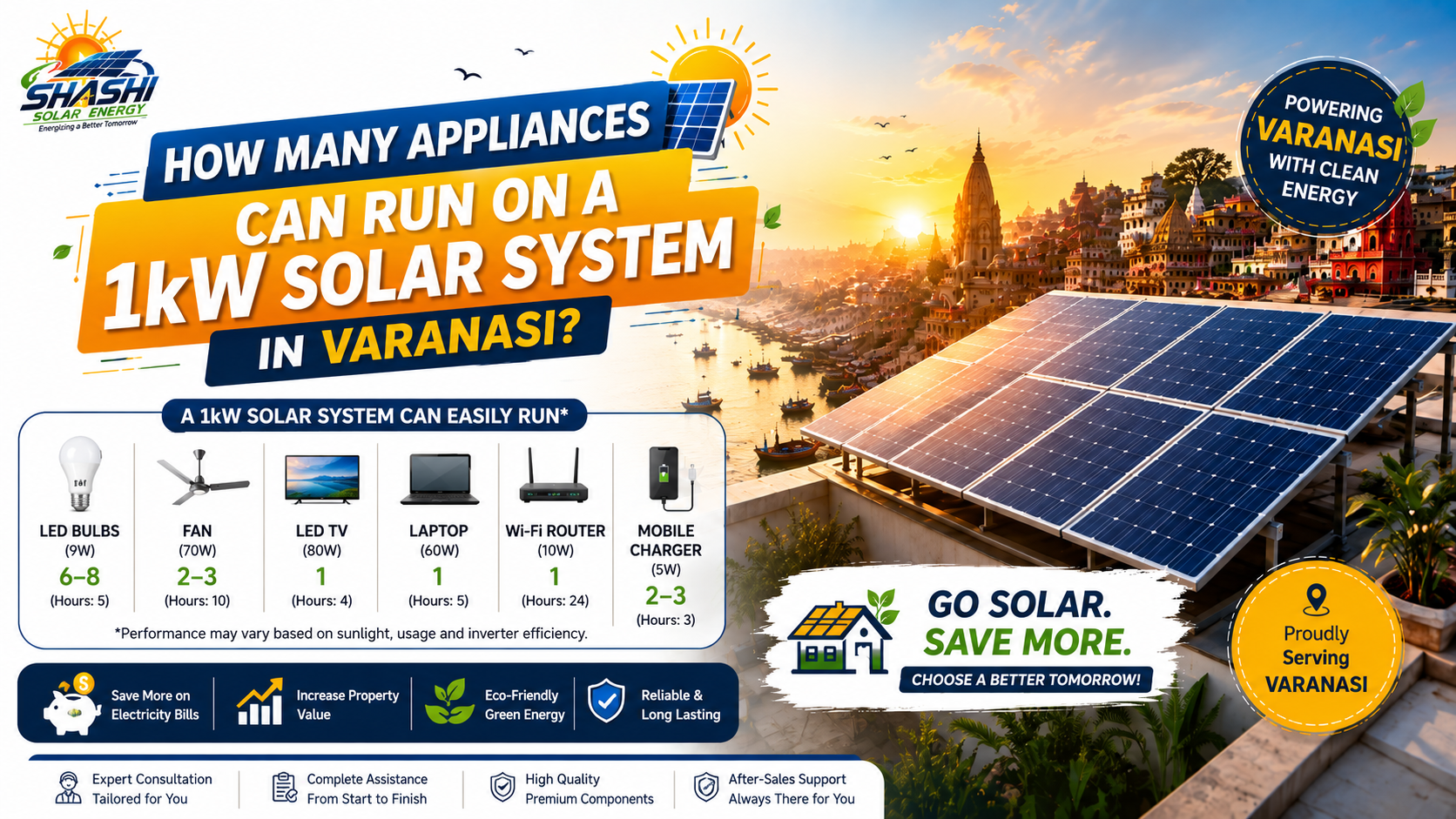
- 4 to 6 LED lights
- 3 to 4 ceiling fans
- One LED TV
- Wi-Fi router
- Laptop
- Mobile charging
- Water purifier
- Small refrigerator
Simultaneous Appliance Usage Capacity
A 1kW system can generally support a combined running load of around 700-900 watts during peak solar production.
Example: 4 LED lights = 40W, 3 ceiling fans = 225W, LED TV = 100W, laptop = 60W, Wi-Fi router = 15W, and refrigerator = 150W. Total load is approximately 590W, so this setup can comfortably operate during daytime solar production.
Understanding Power Consumption Before Installation
Before choosing a solar system, homeowners should review monthly electricity bills, daily appliance usage, peak load requirements, and future electricity consumption plans. A professional energy audit helps determine whether a 1kW system is sufficient. A trusted Solar Company in Varanasi can help match appliance load with the right solar capacity.
List of Appliances That Can Run on a 1kW Solar System
LED Lights
LED lighting is one of the most energy-efficient applications for solar energy. A 1kW system can easily run 8 to 10 LED bulbs of 9W each and support multiple rooms simultaneously.
Ceiling Fans
Modern ceiling fans typically consume 50W to 75W. A 1kW solar system can operate 3 to 5 ceiling fans for several hours daily.
LED Television
Most LED televisions consume between 60W and 120W. A solar-powered home can comfortably run one LED TV, streaming devices, and set-top boxes.
Wi-Fi Router
Wi-Fi routers usually consume only 10W to 20W, which makes them ideal for solar-powered households.
Laptop and Mobile Charging
A laptop generally consumes 40W to 90W. Mobile charging requirements are minimal, making solar energy ideal for work-from-home users.
Refrigerator
A modern refrigerator can operate on a 1kW solar system, provided overall energy consumption is managed properly.
Water Purifier
RO water purifiers consume relatively little electricity and can be comfortably supported by a 1kW solar setup.
Before finalizing appliance usage, homeowners can also check the BEE Star Label portal to compare energy-efficient appliances and plan a more practical connected load for a 1kW solar system.
Can a 1kW Solar System Run a Refrigerator?
Many homeowners considering a 1kW Solar System in Varanasi want to know whether it can handle one of the most important household appliances: the refrigerator. Modern energy-efficient refrigerators can generally operate on a properly designed solar system.
Refrigerator Power Requirements
A typical refrigerator consumes 100W to 250W while running and 1 to 2 units of electricity per day depending on size and efficiency. Modern inverter refrigerators consume significantly less energy than older models, making them ideal for solar-powered homes.
Daily Energy Consumption Analysis
Let us assume refrigerator = 1.2 units/day, 3 ceiling fans = 1.5 units/day, LED lights = 0.4 units/day, TV = 0.5 units/day, and router plus charging = 0.2 units/day. Total consumption is around 3.8 units/day.
Since a 1kW rooftop solar system in Varanasi can generate approximately 4-5 units daily, this setup can work efficiently when energy usage is managed properly.
Can a 1kW Solar System Run an Air Conditioner?
Air conditioners are among the highest electricity-consuming appliances found in homes.
Power Consumption of Different AC Types
- 0.8 Ton Inverter AC: 600W-900W
- 1 Ton Inverter AC: 800W-1200W
- 1.5 Ton Inverter AC: 1200W-1800W
Limitations of a 1kW Solar System
Although a 1kW home solar system may temporarily operate a small inverter AC during peak sunlight hours, it is generally not recommended as the primary power source for air conditioning.
Reasons include high startup power demand, reduced power availability for other appliances, increased battery requirements, and limited solar generation capacity. Homeowners who regularly use air conditioners should typically consider a 3kW, 5kW, or larger solar power solution for homes.
Can a 1kW Solar System Run a Washing Machine?
A washing machine can be operated using a solar system, but timing is important.
Energy Usage of Washing Machines
- Semi-automatic washing machine: 300W-500W
- Fully automatic washing machine: 500W-1000W
Most washing cycles last between 30 and 60 minutes.
Best Time to Operate High-Power Appliances
For maximum efficiency, run washing machines during peak sunlight hours, operate between 11 AM and 3 PM, and avoid simultaneous use of multiple heavy appliances. This strategy allows direct utilization of solar energy without excessive battery discharge.
Appliances Not Recommended for a 1kW Solar System
A small rooftop solar system has limitations. Certain appliances may exceed its practical capacity.
Electric Geysers
Electric water heaters typically consume 1500W to 3000W, which is significantly higher than the output of a 1kW system.
Induction Cooktops
Induction cooktops often require 1200W to 2500W. Running them regularly on a 1kW system is not practical.
Multiple Air Conditioners
Operating multiple AC units would require a much larger solar setup due to their high energy consumption.
Heavy Industrial Equipment
Industrial machinery, welding equipment, compressors, and commercial appliances are unsuitable for a residential 1kW solar system.
Ideal Household Setup for a 1kW Solar System
Small Family Requirements
A family with basic electricity needs can benefit greatly from a 1kW system. Typical supported load includes 4-6 LED lights, 3-4 ceiling fans, television, Wi-Fi router, mobile charging, laptop, and refrigerator.
1 BHK Apartment Energy Needs
For a 1 BHK apartment with moderate electricity usage, a 1kW Solar System in Varanasi can offset a substantial portion of monthly electricity consumption. This makes it an attractive option for apartment owners seeking lower electricity bills.
Low Electricity Consumption Homes
Homes consuming approximately 100-150 units per month are often ideal candidates for a 1kW solar installation.
If you are planning to install solar panels on your home or commercial building, choosing a reliable Rooftop Solar Company in Varanasi can simplify the process. From site assessment and system design to installation and maintenance, expert guidance helps ensure maximum solar savings.
How Much Electricity Bill Can a 1kW Solar System Save?
One of the biggest advantages of installing a renewable energy system is long-term savings.
Estimated Monthly Savings
With average generation of 120-150 units per month, homeowners may save ₹700 to ₹1,200 per month, depending on local electricity tariffs.
Annual Savings Potential
Annual savings can reach ₹8,000 to ₹15,000+ depending on usage patterns and electricity rates.
Return on Investment
A well-installed system can often recover its investment within several years through electricity bill reductions and government subsidies. You can compare system size economics in our Solar Panel Price in Varanasi guide.
By working with a trusted Solar Power Company in Varanasi, homeowners and businesses can take advantage of advanced solar technologies, government incentives, and long-term electricity savings. A well-designed solar power system delivers reliable energy generation for decades.
A professional Solar Energy Company in Varanasi provides customized renewable energy solutions that help reduce dependence on conventional electricity sources. Investing in solar energy can lower utility bills, increase energy independence, and support a cleaner environment.
1kW Solar System with Battery vs Without Battery
Backup Power Benefits
Battery-based systems offer power during outages, greater energy independence, and better utilization of excess solar energy.
Appliance Usage During Power Cuts
With battery storage, essential appliances such as fans, LED lights, Wi-Fi router, mobile charging, and television can continue operating during grid failures.
Cost Comparison
On-grid systems usually have lower installation cost, higher ROI, and net metering benefits. Battery-backed systems have higher upfront cost, backup power availability, and greater energy security.
The right choice depends on your budget and power outage frequency. If backup is important, compare a hybrid solar system before finalizing your setup.
Is a 1kW Solar System Enough for Your Home?
When a 1kW System Is the Right Choice
- Monthly consumption is below 150 units
- You live in a small home or apartment
- You primarily use lights, fans, TV, and electronics
- You want to reduce electricity bills
Signs You Need a Larger Solar System
- You use air conditioners regularly
- Monthly consumption exceeds 200 units
- You operate multiple refrigerators
- You own high-power appliances
Comparing 1kW, 2kW and 3kW Solar Systems
1kW System: Small homes, basic appliances, and low investment.
2kW System: Medium households, higher savings, and better flexibility.
3kW System: Larger families, AC support, and greater energy independence.
Factors That Affect Appliance Usage on a 1kW Solar System
Sunlight Availability
Varanasi enjoys strong solar potential, but seasonal variations affect power generation. For location-wise solar resource context, homeowners can also refer to the Global Solar Atlas before estimating expected generation from a rooftop system.
Panel Efficiency
High-efficiency panels produce more electricity from the same roof area.
Battery Capacity
Battery size determines how long appliances can operate after sunset.
Appliance Energy Ratings
Choosing energy-efficient appliances significantly improves overall solar performance. LED bulbs, BLDC fans, inverter refrigerators, and efficient televisions can help a 1kW system support more daily usage.
Partnering with an experienced Solar Installation Company in Varanasi ensures that your rooftop solar system is installed safely and efficiently. Professional installation helps maximize energy generation, improve system reliability, and extend the lifespan of your solar investment.
Conclusion
A 1kW Solar System in Varanasi is a practical choice for small homes, apartments, and low-consumption households that mostly use lights, fans, TV, Wi-Fi, charging, laptop, water purifier, and a small refrigerator.
It is not the right choice for heavy appliances such as geysers, induction cooktops, multiple AC units, or industrial loads. For those requirements, a larger system is more reliable and financially sensible.
The best way to decide is to review your electricity bill, calculate appliance load, inspect rooftop space, and compare on-grid or hybrid options. With proper sizing and quality installation, a 1kW solar system can reduce monthly bills and make your home more energy independent.
For customers comparing service coverage beyond Varanasi, working with a solar company in Uttar Pradesh can also help plan rooftop solar support across nearby cities and districts.
FAQ: 1kW Solar System in Varanasi
How many appliances can run on a 1kW solar system in Varanasi?
A 1kW system can usually support basic appliances such as LED lights, ceiling fans, TV, Wi-Fi router, laptop, mobile charging, water purifier, and a small refrigerator when usage is managed carefully.
How many units does a 1kW solar system generate daily?
In Varanasi, a 1kW solar system typically generates around 4 to 5 units per day in average conditions, depending on sunlight, roof direction, shading, and installation quality.
Can a 1kW solar system run a refrigerator?
Yes, a modern energy-efficient refrigerator can run on a 1kW solar system if the total household load is managed properly.
Can a 1kW solar system run an air conditioner?
It is generally not recommended. Air conditioners consume high power, and a 1kW solar system has limited capacity. A 3kW or 5kW system is usually more suitable for AC usage.
Is a 1kW solar system enough for a 1 BHK home?
Yes, it can be suitable for a 1 BHK home with basic appliance usage and monthly consumption around 100-150 units.
Need help checking whether a 1kW solar system is enough for your home in Varanasi?